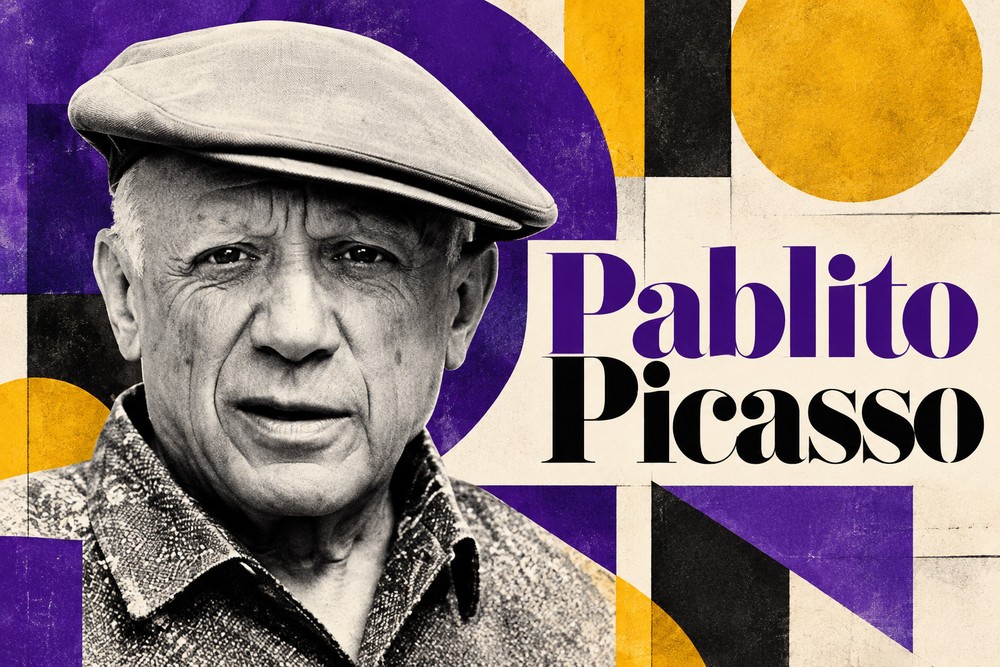
I have always felt that some lives unfold like silhouettes against brighter lights. Pablito Picasso’s story is such a silhouette. He was born into a dynasty that changed the course of art, yet his short life traced a quieter, more fragile line. His name carried the weight of genius, but his days were defined by family fractures, distance, and an ending that still stings when retold.
A Brief Life in a Vast Shadow
Pablito Picasso, born on May 5, 1949 in Paris, was named after his legendary grandfather, Pablo Picasso. The nickname Pablito kept him distinct within a family where the air was thick with art, fame, and complicated loyalties. Childhood did not offer a solid foundation. His parents separated soon after his sister Marina arrived in 1950, and he grew up under the pall of adult conflicts neither of his making nor his solving.
His life ended at just 24. In April 1973, on the day his grandfather died, Pablito attempted suicide after being denied access to the funeral. He had ingested a corrosive solvent and succumbed to his injuries on July 11, 1973. In the span of three months, the brightest light of the family was extinguished, and one of its most vulnerable shadows faded with it.
The Picasso Family Web
Families are constellations, and the Picasso web is dense. Pablito’s father, Paulo Picasso, was Pablo’s only legitimate child with the dancer Olga Khokhlova. Paulo worked for his father as a chauffeur and struggled with addiction, dying of liver cirrhosis in 1975. Pablito’s mother, Émilienne Lotte, was Paulo’s first wife. Their split left Pablito and his sister in a fractured home.
Marina Picasso, born November 14, 1950, became one of the family’s most candid voices. Her memoir peeled back the veil on the isolation and neglect she felt, and her philanthropy has often drawn on the wealth of the Picasso estate to support causes close to her heart.
There are broader branches. A name that often surfaces in the family’s cultural roles is Bernard Ruiz-Picasso, associated with museum leadership and preservation. In some family accounts he is cited as a half-brother from Paulo’s later relationship, and he is widely known for cofounding the Picasso Museum in Málaga and for stewardship of certain legacy aspects.
Pablito’s grandfather, Pablo Picasso, needs no introduction. His mother’s side carried grace and discipline through Olga, a Russian ballerina who died in 1955. Pablo’s second wife, Jacqueline Roque, looms large in Pablito’s final chapter. She reportedly barred certain family members from attending Pablo’s funeral, and that single act sits at the heart of Pablito’s distress and death.
Beyond the immediate circle are aunts and uncles who shaped the estate and reputation. Maya Widmaier-Picasso, born to Marie-Thérèse Walter, became an art expert. Claude Picasso, born to Françoise Gilot, led the Picasso Administration for decades, overseeing authenticities and intellectual rights. Paloma Picasso found her own path in design, her work reflecting a personal aesthetic rather than her father’s brush. The family includes cousins such as Olivier Widmaier Picasso, who has discussed the business and culture surrounding the Picasso name.
Estrangement, Funeral, and Aftermath
There are moments when a single door closing becomes a symbol. For Pablito, that door was the entrance to his grandfather’s funeral in April 1973. He was barred from the ceremony. What followed was a desperate act that would prove irreversible. He drank a chemical solvent and was hospitalized for months. He died on July 11, drawing a line under a life whose conflicts were not his own and whose sorrow was both intimate and public.
Jacqueline Roque’s role in this episode cannot be untangled from the family’s larger history of control, loyalty, and exclusion. Her own life ended by suicide in 1986. The family’s tragedies read like a ledger of unhealed wounds.
Work, Achievements, and the Silence
There is scant record of Pablito’s ambitions or career. He died before twenty five, eclipsed by the gravity of being a Picasso without the means to define himself. In a family where achievements were counted in masterpieces, he remained largely absent from public accomplishment. The silence around his life is itself a kind of narrative. He left no spouse or children and no portfolio of works or positions to be cataloged.
Money, Inheritance, and a Mountain of Paintings
When the Picasso estate was formally inventoried in 1980, it was valued at hundreds of millions. Adjusted to the present, those works, rights, and properties are worth billions. Paintings, sculptures, ceramics, archives, and reproduction rights form a mountain of value that casts long shadows on family dynamics. As Paulo’s heir, Pablito had a connection to this estate. Yet his death in 1973 came before his father’s in 1975, constraining any direct inheritance. The shares later aligned around surviving heirs, with administration, licensing, and sales shaping decades of outcomes.
The business of Pablo Picasso’s legacy has been relentless. Authenticity rulings, loan agreements, museum collaborations, and legal disputes have rolled on year after year. The machinery of reputation moved forward even as the human stories behind it, like Pablito’s, receded into the margins.
The Wider Clan and the Business of Legacy
Maya brought expertise and lineage to bear in scholarship and estate matters. Claude’s administrative tenure codified a modern framework for intellectual property and authentication, protecting the brand while mediating between market and heritage. Paloma pursued beauty in her own idiom, through jewelry and design, without competing with the canvases that defined her father. Marina wrote and remembered. Bernard, connected to institutional stewardship, helped cement the family’s place in the global museum ecosystem.
Around them, exhibitions and anniversaries have kept the name in lights. The Picasso Administration’s vigilance against forgeries and misuses has been constant. Public events have raised funds and profile. In this swirl, Pablito’s name rarely appears. His absence is not an oversight. It is the residue of a life cut off before identity had a chance to take shape.
Why Pablito Matters
I think of Pablito as a quiet figure at the edge of a crowded stage. The actors speak loudly. The critics argue. The lights burn hot. He stands there, uncelebrated, and yet his presence changes the scene. His story reminds me that fame does not heal fractures, and genius does not prevent grief. It underscores how legacies are built not only with canvases and signatures but with choices at kitchen tables, doors opened or closed, and the courage or failure to hold a family together.
FAQ
Who was Pablito Picasso?
Pablito Picasso was the eldest grandson of Pablo Picasso. He was born on May 5, 1949 in Paris, named after his grandfather, and died at 24 in 1973. His life unfolded in the shadow of family turmoil and the immense weight of the Picasso name.
How did he die and why is the funeral incident significant?
He attempted suicide on the day Pablo Picasso died, after being barred from the funeral. He ingested a corrosive solvent and passed away in July 1973 following months in the hospital. The funeral incident is emblematic of the family’s deep estrangements and the emotional toll they took on him.
Did he have a career or public achievements?
There is no verified record of a formal career or public achievements. He died young and left little trace in professional or artistic terms. His story is known primarily through family accounts and the tragic circumstances of his death.
What is known about his net worth or inheritance?
No Pablito net worth is known. He was related to the Picasso estate as Paulo Picasso’s son. The 1973 death predates his father’s 1975 death, limiting any direct inheritance. Survivors and administrators have handled artworks, rights, and royalties to value the estate in billions.
Who were his immediate family members?
His father was Paulo Picasso, Pablo’s legitimate son with Olga Khokhlova. His mother was Émilienne Lotte. He had a sister, Marina Picasso. Some accounts link Bernard Ruiz-Picasso to Paulo’s later relationship, while broader family members include Maya Widmaier-Picasso, Claude Picasso, and Paloma Picasso.
Is he mentioned in recent news or social media?
He is rarely mentioned today. Most coverage focuses on exhibitions, auctions, and the activities of living heirs. Pablito’s early death and private life mean he does not appear in current news cycles or social media narratives.
How does his story relate to the broader Picasso estate disputes?
His story sits at the intersection of grief and inheritance. The Picasso estate required years of inventory and legal resolution, and its stewardship has involved complex negotiations. Pablito’s death became part of the family’s tragic lore, illustrating the personal cost of a legacy that was vast, valuable, and often contentious.
Did Pablito have a spouse or children?
No spouse or children are documented. His short life and the private nature of his personal relationships left few public records.