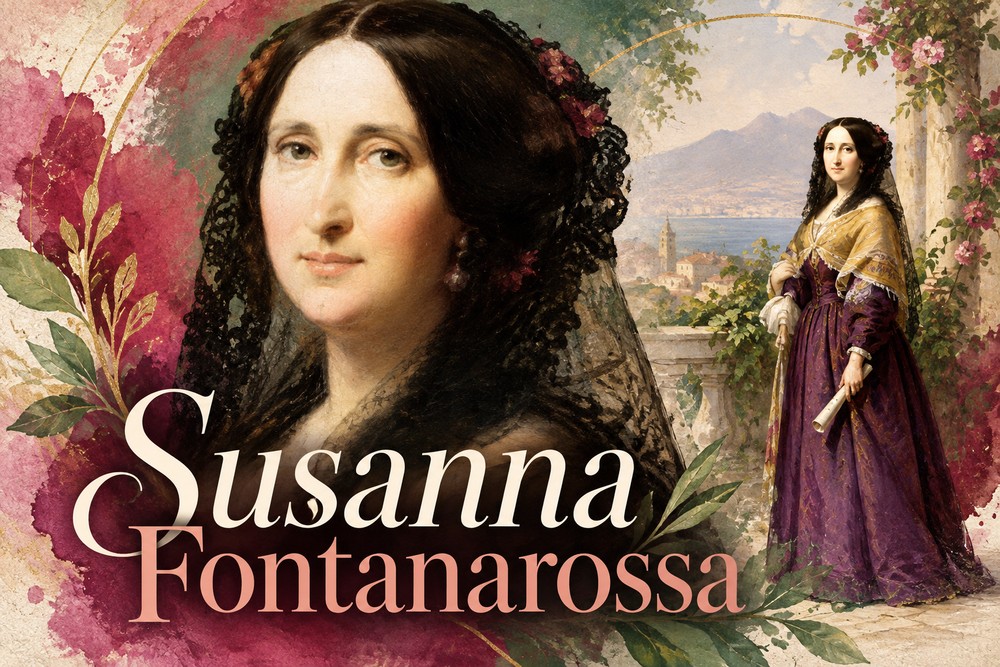
A Genoese mother at the heart of a world-changing story
When I think of global turning points, I imagine maps unrolling and sails billowing. Yet the wind that filled those sails began at a hearth. Susanna Fontanarossa, the Genoese mother of Cristoforo Columbus, stands in the historical record like a modest doorway that opens onto oceans. She does not command headlines or grand titles. She appears in notarial lines and family references, her name braided to the daily life of artisans and small merchants. Through her household and children, the quiet labor of a working family helped launch the journey that would redraw hemispheres.
Name, origins, and household
Her name appears in documents as Sozana or Susanna de Jacobi de Fontana Rubea, which signals family belonging rather than an aristocratic lineage. I read that phrasing as a small window into kin and place. Fontanarossa is tied to the Genoese region, often associated with hill villages around the Bisagno valley. The patronymic de Jacobi suggests her father was named Giacomo. If I could walk those lanes, I would expect to hear woven threads tapping the loom and gossip pooling around the baker’s doorway.
She married Domenico Colombo, known in Genoa as a wool weaver and a man of small enterprise. He tried his hand at weaving, and at times tavern keeping or selling cheese. Nothing glitzy. Just the honest commerce that keeps a city breathing. Together, Susanna and Domenico built a household whose rhythms were shaped by work, the whirr of spinning, the smell of tallow and dye, and the chatter of children who would later flood outward toward the sea.
Children who carried the family across oceans
The household’s sons and daughter form a constellation around Susanna. Cristoforo, known to the world as Christopher Columbus, was born around 1451, and his life needs no lengthy retelling here. Yet his mother’s name anchors his origin. It is Susanna’s everyday world that underwrites his extraordinary one.
Bartolomeo, brother and collaborator, worked with maps and joined the ventures that turned ideas into voyages. Giovanni Pellegrino, listed in records with a pilgrim’s name, seems to have died young, leaving a lighter footprint in the archive. Giacomo, sometimes tangled in later translations and Spanish renderings, appears in the Genoese family lists alongside his brothers. A daughter, often called Bianchinetta, rounds out the picture, her diminutive name catching the tone of affection common in family records.
Through Cristoforo, Susanna’s grandchildren take on sharper outlines. Diego Colón, the elder, pursued titles and the complex inheritance of his father’s claims. Ferdinand, also known as Hernando or Fernando, left a more literary legacy and a life steeped in books. In their stories, I hear the echo of a Genoese mother whose name survives because her children stepped into public life.
The archival echo
The documentary trail is modest. Susanna’s presence emerges from notarial documents that name her as the wife of Domenico and mother of Cristoforo and Pellegrino. The phrasing is spare. A sale here, a family reference there. For historians, such entries are a compass point. I can almost feel the clerk’s quill scratching as the transaction fixes names in ink. Between those lines lies the daily work of feeding children, settling accounts, and walking familiar streets.
Daily life and social place
There is no evidence that Susanna held a formal office or had a career in the modern sense. Her world was domestic and local, the province of mothers who made households function. The social place here is vital. Genoa in the fifteenth century thrummed with trade, small industries, and maritime bustle. A wool weaver’s family would be close to the city’s economic heartbeat, not at the elite core, yet never far from opportunity. The qualities required to keep such a home together are not recorded in titles. They are felt in the dependable cadence of work.
I often picture her as the steady center of the room. The table cleared, threads gathered, children’s voices cutting across afternoon light. Her life may have had no grand stage, but the stagehands of history keep the show running.
Dates and uncertainties
Susanna’s birth is usually placed around 1435. Her marriage to Domenico falls into the mid 1440s, a plausible window given the ages of their children in the 1450s and 1460s. She seems to have died before 1484, and certainly by 1489, with Domenico living on into the 1490s. These dates sketch a life lived across the hinge of two eras, the seasoned medieval city feeding the appetite of early modern exploration.
Dates in family reconstructions carry a gentle caution. Documents survived by chance, and scribes did not record everything. I read these timelines as careful estimates derived from scattered entries. That is how many ordinary lives appear on the page, like starlight traced through gaps in cloud.
Names, variations, and the fog of translation
Genoa speaks in Italian, Spain in Spanish, and archives speak in Latin. It is no surprise that name variants appear. Cristoforo becomes Christopher in English. Giacomo can morph into Diego in Spanish contexts, a translation trail that can blur identities when brothers share similar or adapted names. The daughter’s name Bianchinetta carries a diminutive warmth that suggests either youth or affection, not a formal legal identity. When reading such lists, I keep a careful eye on spelling and context. Consonants shift like tides.
The family’s place in larger history
Susanna’s story, modest as it is, gives shape to the larger narrative. The voyages that crossed the Atlantic did not spring from an empty stage. They relied on a network of learning, labor, and relationships. A mother raising sons in a working-class Genoese home was part of the supply chain of imagination and resolve. If exploration is a cathedral, mothers are the stonecutters whose names rarely get carved into the façade.
FAQ
Who was Susanna Fontanarossa?
She was a woman of the Genoese region whose name appears in notarial records as the wife of Domenico Colombo and the mother of Cristoforo Columbus. Her life is primarily glimpsed through family and property references rather than public roles.
Where did she come from?
Her recorded designation places her within the Fontanarossa family associated with the Genoese area, often linked to villages around the Bisagno valley. The patronymic suggests her father was named Giacomo, anchoring her to a local kin group rather than a formal noble house.
Did she have a career?
There is no evidence of a career in the modern sense. Surviving documentation presents her in a familial context. Her household with Domenico Colombo belonged to the artisan and small merchant world of Genoa, centered on weaving and modest trade.
Who were her children?
The family roster most consistently reported includes Cristoforo, Bartolomeo, Giovanni Pellegrino, Giacomo, and a daughter often called Bianchinetta. Cristoforo became the famous navigator. Bartolomeo collaborated on voyages and mapping. Pellegrino is believed to have died young. Giacomo appears in Genoese records with later confusion arising from name variants. The daughter’s presence is attested in family lists.
What about her grandchildren?
Two of her grandsons stand out because of Cristoforo’s public life. Diego Colón pursued his father’s titles, and Ferdinand, also known as Hernando, became a notable bibliophile and chronicler of his father’s career.
How certain are the dates of her life?
Her birth is commonly placed around 1435, with marriage in the mid 1440s. She died before 1484 and by 1489 in most accounts. These dates are derived from surviving records and should be read as informed estimates rather than precise certainties.
Why is her story sparse?
Women of her social standing rarely appear in extensive documents unless tied to property, marriage, or legal transactions. Her name survives where it intersected with recorded matters. The larger canvas of daily life was seldom written down.
Is Giacomo the same as Diego in her family records?
Giacomo is the Italian form. Diego is the Spanish form that can overlap in translation. In the Columbus family, such variations sometimes conflate individuals across languages and contexts. Careful reading of specific documents helps untangle these threads, but some ambiguity persists.
What was Domenico Colombo’s work?
Domenico was a wool weaver and small-scale merchant. Records also connect him at times with tavern keeping and selling cheese. His occupations place the family within the lower middle tiers of Genoese society, connected to the city’s everyday economy.